d Orbital Splitting Diagrams
| Draw and label the energy levels for the d orbitals in a coordination complex for the indicated geometry. | ||
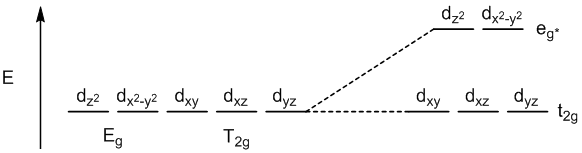
| 1. | octahedral geometry | [Solution] |
| 2. | octahedral geometry with π-acceptor ligands | [Solution] |
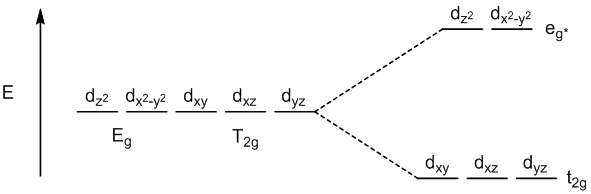
| 3. | octahedral geometry with π-donnor ligands | [Solution] |
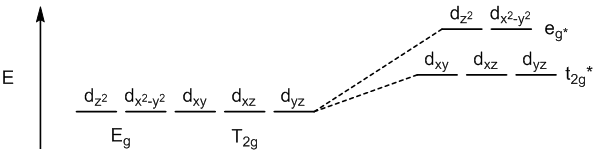
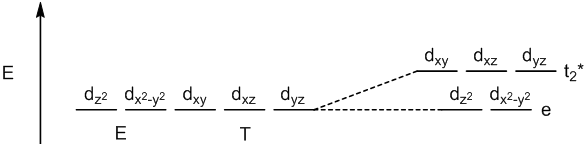
| 4. | tetrahedral geometry | [Solution] |
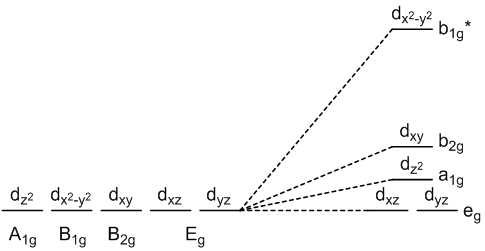
| 5. | square planar geometry | [Solution] |
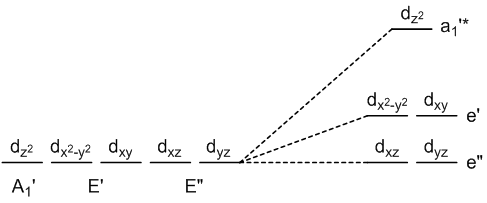
| 6. | trigonal bipyramidal geometry | [Solution] |
| 7. | square pyramidal geometry (axial-base angle = 90°) | [Solution] |
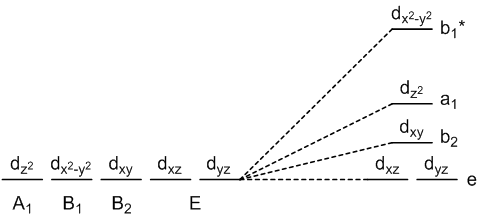
| 8. | square pyramidal geometry (axial-base angle > 90°) | [Solution] |
Solutions
| 1. |
octahedral geometry
|
[Back to Questions] |
| 2. |
octahedral geometry with π-acceptor ligands
|
[Back to Questions] |
| 3. |
octahedral geometry with π-donnor ligands
|
[Back to Questions] |
| 4. |
tetrahedral geometry
|
[Back to Questions] |
| 5. |
square planar geometry
|
[Back to Questions] |
| 6. |
trigonal bipyramidal geometry
|
[Back to Questions] |
| 7. |
square pyramidal geometry (axial-base angle = 90°)
|
[Back to Questions] |
| 8. |
square pyramidal geometry (axial-base angle > 90°)
|
[Back to Questions] |